Building Fitollon: My Personal Health & Fitness Ecosystem
2026-10-19
I've been tracking my training, nutrition, body weight, and daily activity for quite some time. The problem was never a lack of data. It was that everything lived in different places.
I use MacroFactor for nutrition and weight tracking, Apple Health for daily activity and Apple Watch metrics, and separate notes for my training sessions. I also regularly use ChatGPT to discuss my workouts, progress, and nutrition.
But there was one annoying part: every time I wanted to ask something meaningful, I had to provide the context myself.
How many steps I'd taken, what I'd eaten, how my weight had changed, or what I'd lifted during my previous session. Even though all this information was already recorded somewhere, none of it was readily available to the AI.
That's where Fitollon started.
The Idea
I wanted one place where I could see my health and fitness data, manage my training, and interact with an AI coach that already had access to the relevant information.
Instead of telling ChatGPT what I did at the gym last week, I wanted to simply ask:
- How has my training progressed over the past month?
- What did I lift during my last Upper B session?
- How has my weight been trending compared to my calorie intake?
- Should I make any adjustments to my current training?
The idea was simple: the data should already be there. I should only need to ask the question.
I called the project Fitollon, following the naming tradition of my other personal project, Pipillon. Both names are playful variations of Apollon, my online handle.
What I've Built
Fitollon is currently a personal web application that brings several parts of my fitness routine together.
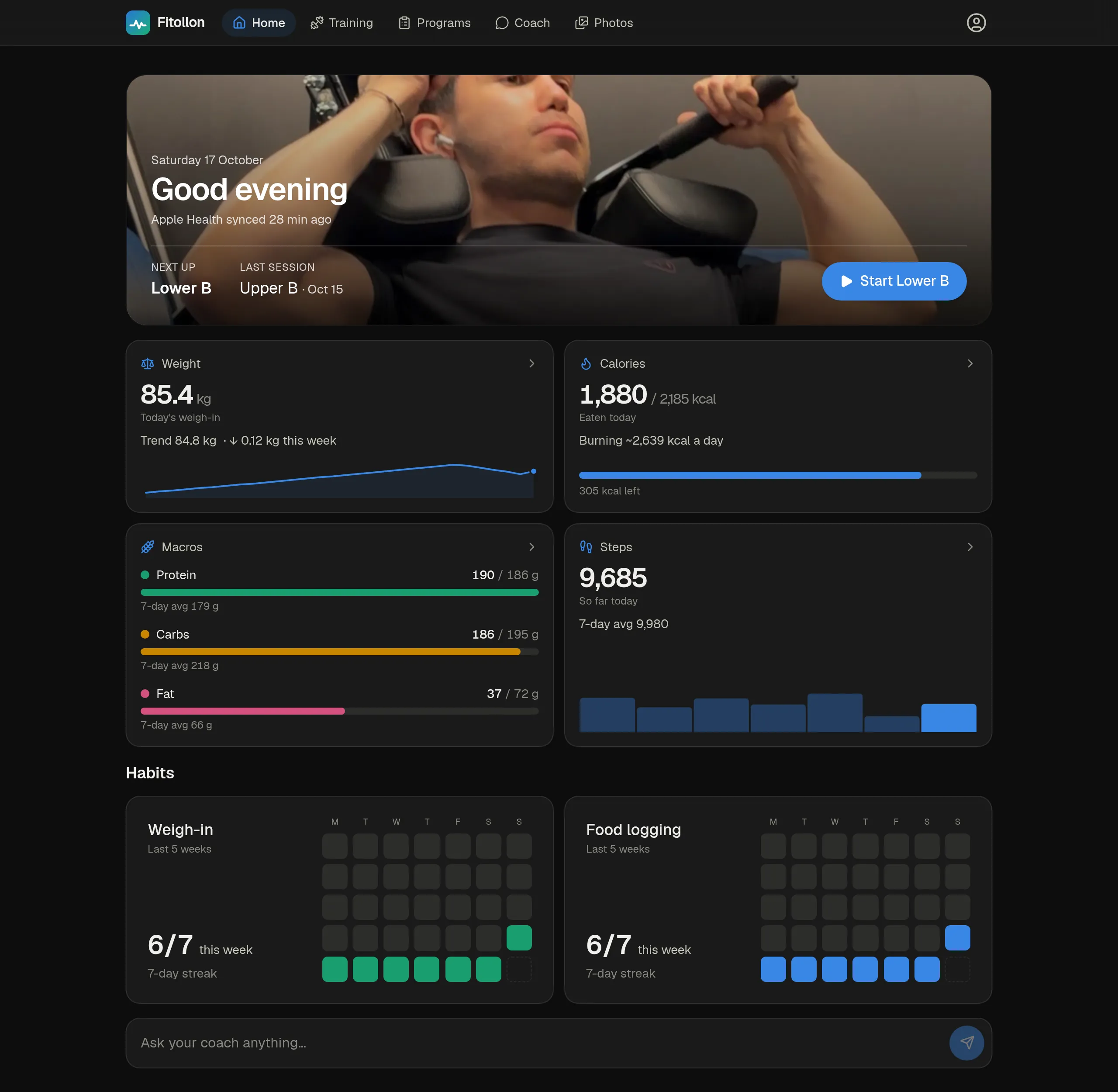
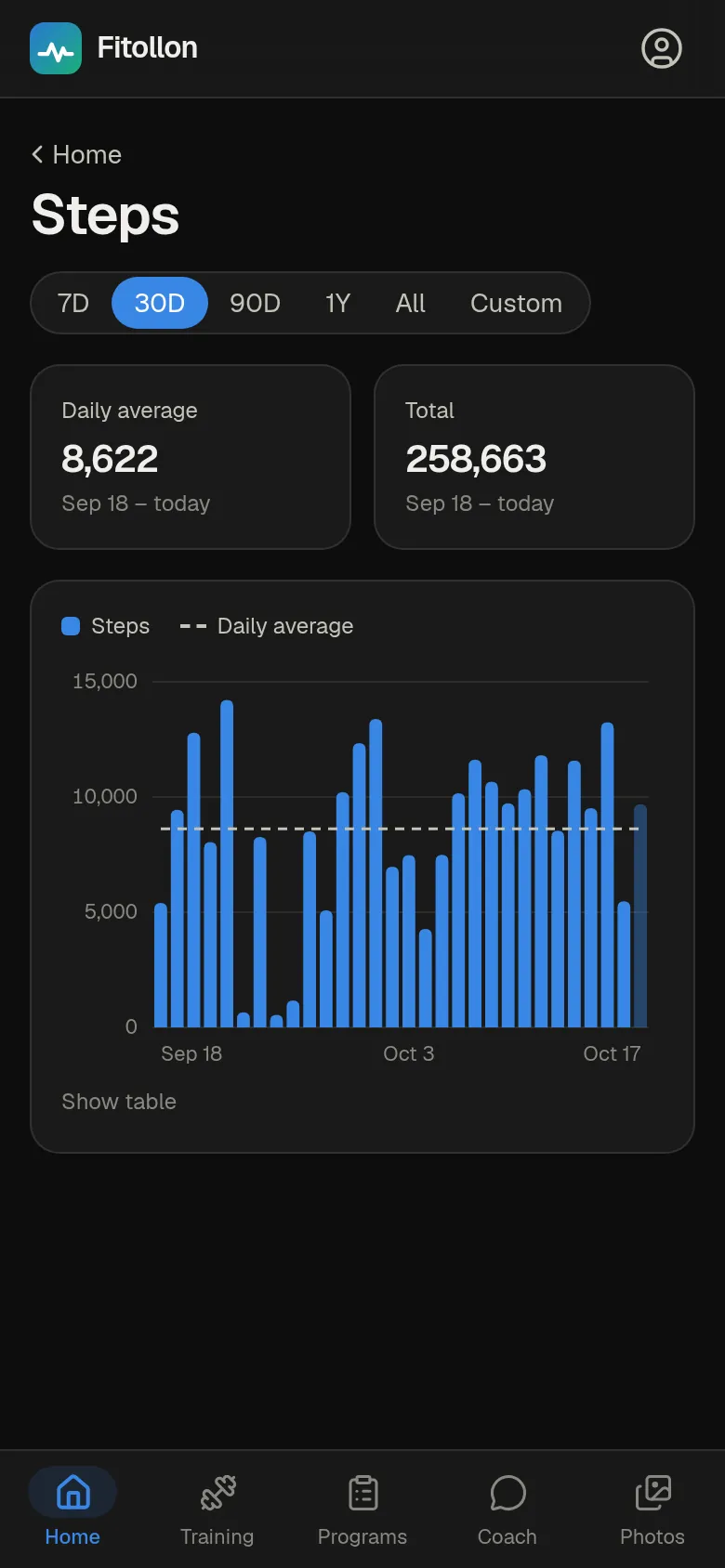
The home dashboard provides an overview of my daily nutrition, weight, steps, and training. I can explore historical trends, compare my nutrition against my goals, and track my progress over time.
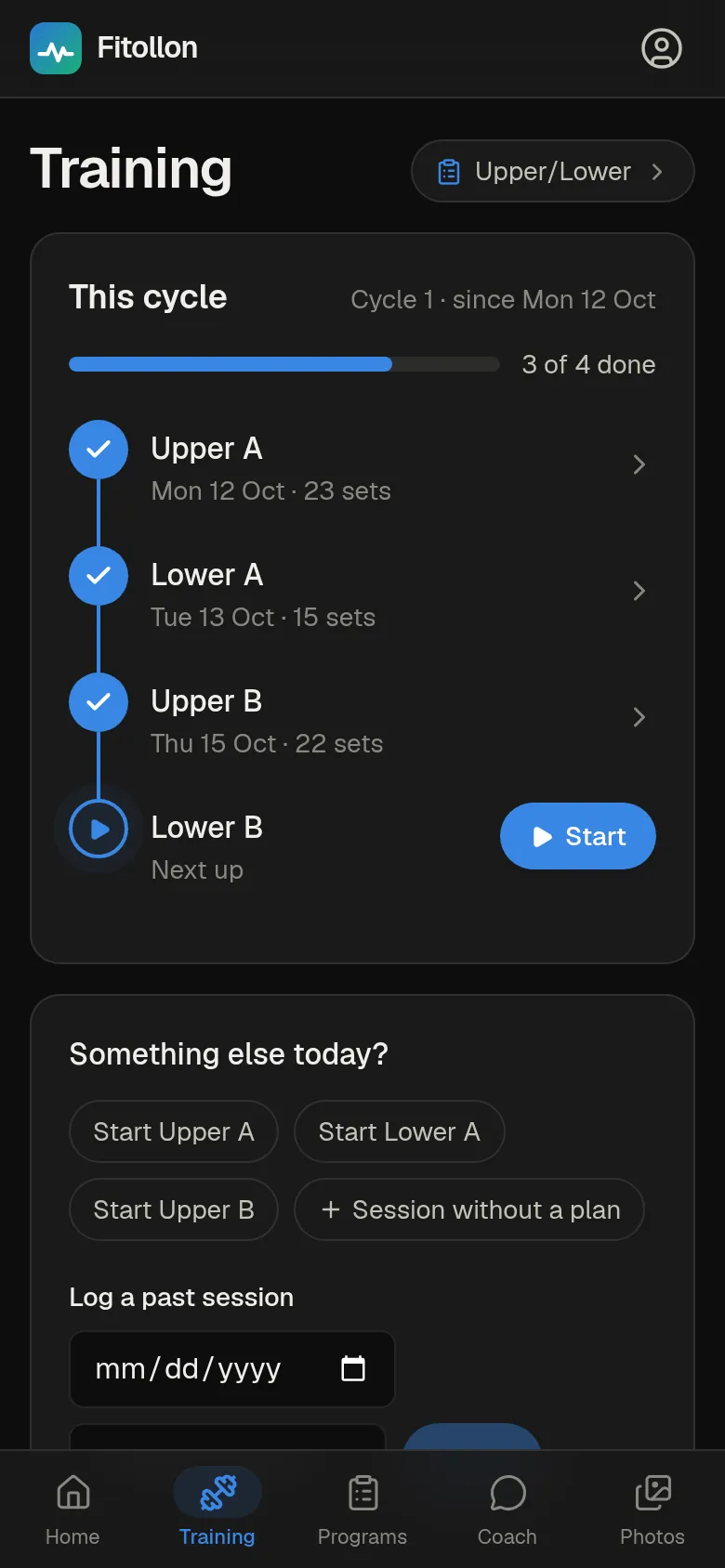
For training, I built a logging system around how I actually work out. I can create multiple programs, organize exercises into sessions, track completed workouts, and keep previous training cycles available for reference.
There's also a photo journal for meals, gym sessions, progress photos, and other activities.
The most interesting part, however, is the AI coach.
An AI Coach With Access to My Data
Rather than treating the AI as a standalone chatbot, I integrated it directly into the application.
The coach can retrieve my nutrition, weight, activity, and training history when answering questions. It can also interact with the application through tools, including logging training sessions, updating nutrition goals, and remembering relevant information across conversations.
For example, I can describe a completed workout in natural language and have the coach record it, rather than manually entering every detail.
The important distinction is that the coach isn't relying entirely on what I remember to tell it. It can look up the relevant information itself.
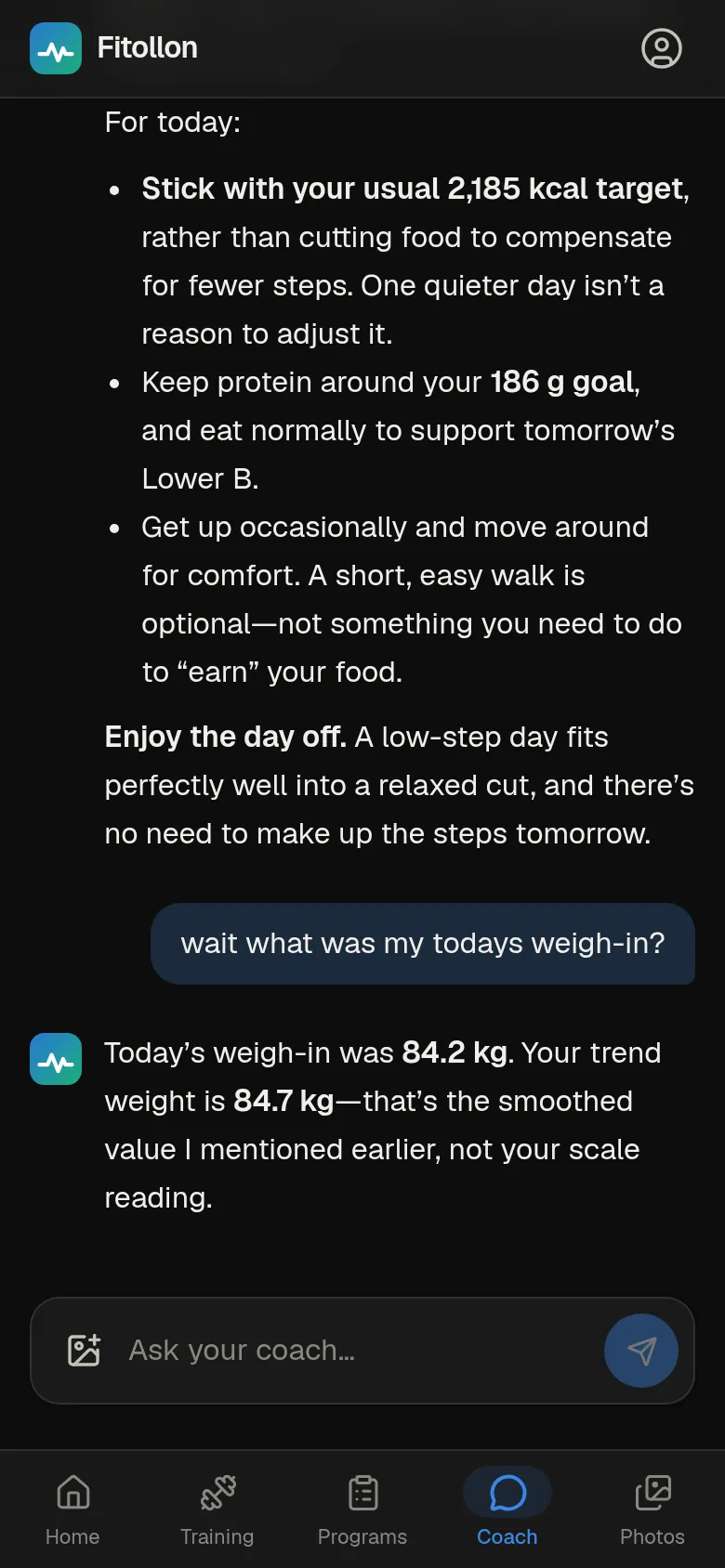
This is what makes Fitollon more useful to me than simply keeping a separate ChatGPT conversation about fitness.
Bringing the Data Together
One of the more interesting challenges was getting information from different applications into a single system.
MacroFactor doesn't provide a public API, but it can write nutrition and weight measurements into Apple Health.
I use Health Auto Export to retrieve that information alongside activity and Apple Watch data and send it to Fitollon's backend.
For information that isn't available through Apple Health, such as historical expenditure estimates, weight trends, and nutrition goals, I built an importer for MacroFactor's data exports.
Fitollon also calculates weight trends and expenditure estimates from the available data.
The result is a system where most of the information I need arrives automatically, without having to enter the same data multiple times.
The Technical Side
Fitollon is built around a relatively straightforward full-stack architecture.
Frontend: Next.js and TypeScript
Backend: Python, FastAPI, SQLAlchemy, and Alembic
Database: PostgreSQL, hosted on Neon
AI: Strands Agents, with support for OpenAI and Anthropic models
Deployment: Vercel, with private Vercel Blob storage for photos and videos
The frontend handles the interface, while the FastAPI backend manages application logic, data ingestion, training records, and AI interactions.
For the AI coach, I used Strands Agents to give the model access to tools that can retrieve and modify application data. The tools allow the coach to interact with structured information instead of depending on an enormous prompt containing my entire history.
I also wanted flexibility when experimenting with different models, so the backend supports switching AI providers through configuration.
Although Fitollon is a web application, it works on mobile and can be added to the iPhone home screen for a more app-like experience.
What I Learned
Building Fitollon has been a useful exercise in connecting several areas of software engineering.
The biggest challenge wasn't creating individual dashboards or charts. It was making different systems work together reliably.
Health data arrives in different formats, some measurements are updated retroactively, and not every application exposes the same information. Handling repeated imports, keeping historical values consistent, and making that data accessible to both the interface and the AI required more thought than I initially expected.
Another interesting part was designing the AI integration.
Giving a language model access to tools is relatively straightforward. Making those tools useful, defining what the model should be allowed to change, and ensuring that it retrieves the correct information are much more important.
It also reinforced something I've increasingly noticed while working on AI projects: the model is only one part of the system. The surrounding infrastructure, data pipelines, application logic, and reliability matter just as much.
What's Next?
Fitollon started as something I wanted for myself, but the more I've worked on it, the more I've started thinking about its potential beyond personal use.
I'm exploring the possibility of turning Fitollon into a standalone product that others could use, and potentially building a business around it. It's still early, and I have a lot to figure out before making any concrete decisions.
For now, I'm continuing to develop the application, improve its integrations, and experiment with what an AI-powered fitness ecosystem could look like.
What started as a way to avoid repeatedly explaining my fitness data to ChatGPT has grown into something much more interesting, and I'm excited to see where it goes.